STAX Generational Trends: Gen Z Goes Conservative

After a multi-generation stock-buying spree in February, younger investors spearheaded a shift toward a slightly more cautious approach last month as the Iran war escalated.
The Schwab Trading Activity Index™ (STAX)—which analyzes Schwab client stock positions and trading to gauge investor sentiment—fell 2.23% month over month to 56.04 in March. It was the steepest monthly drop since May 2025, when investors grappled with President Trump's trade war.
However, March's STAX score was still the second highest since the spring of 2022, signaling Schwab clients remained bullish overall. Older generations, in particular, were largely willing to look past the surge in oil prices, the threat of inflation, and signs of labor market weakness.
On a month-over-month basis, the STAX scores for the Silent Generation (born before 1946) and Baby Boomers (born 1946–1964) barely budged, slipping just 0.05% and 0.62%, respectively.
Gen X investors (born 1965–1980), who posted a record-high STAX score in February, were also largely unfazed by the conflict. Gen X has consistently posted the highest STAX score among all generations since Schwab began tracking generational data in June 2024, and that trend continued in March. Their STAX score dropped just 1.8% month over month to 64.52—its second-highest level on record.
Millennials (born 1981–1996) were slightly less bullish. Their STAX score fell 3.8% to 53.57. The month-over-month drop was significant, but March's score was still Millennials' fourth-highest tally since June 2024.
In contrast, younger investors have been more conservative amid increasing economic and geopolitical uncertainty.
On a month-over-month basis, Gen Z's (born 1997–2012) STAX score slipped 4.7% to 43.95, while Gen Alpha's (born 2013–2024) score sank 5.8% to 44.00. However, a percentage of these generations' accounts are directed by guardians, who may be taking a more conservative approach when managing the money of their dependents.
"We continue to see the gap widen between Gen X and Gen Z in terms of risk tolerance," said Joe Mazzola, head trading and derivatives strategist at Schwab. "Gex X has shown a willingness to buy market dips, especially in the Mag7, while Gen Z has displayed more risk aversion."
The gap between older and younger investors' sentiment has grown significantly since May 2025, with older investors continually proving to be more bullish.
Interestingly, when it comes to consumers' sentiment, the roles are flipped. Gen Z and Millennials have been the most optimistic generations by a wide margin over the past five years, according to The Conference Board's Consumer Confidence Index. Gen X and Baby Boomers, meanwhile, have been consistently glum.
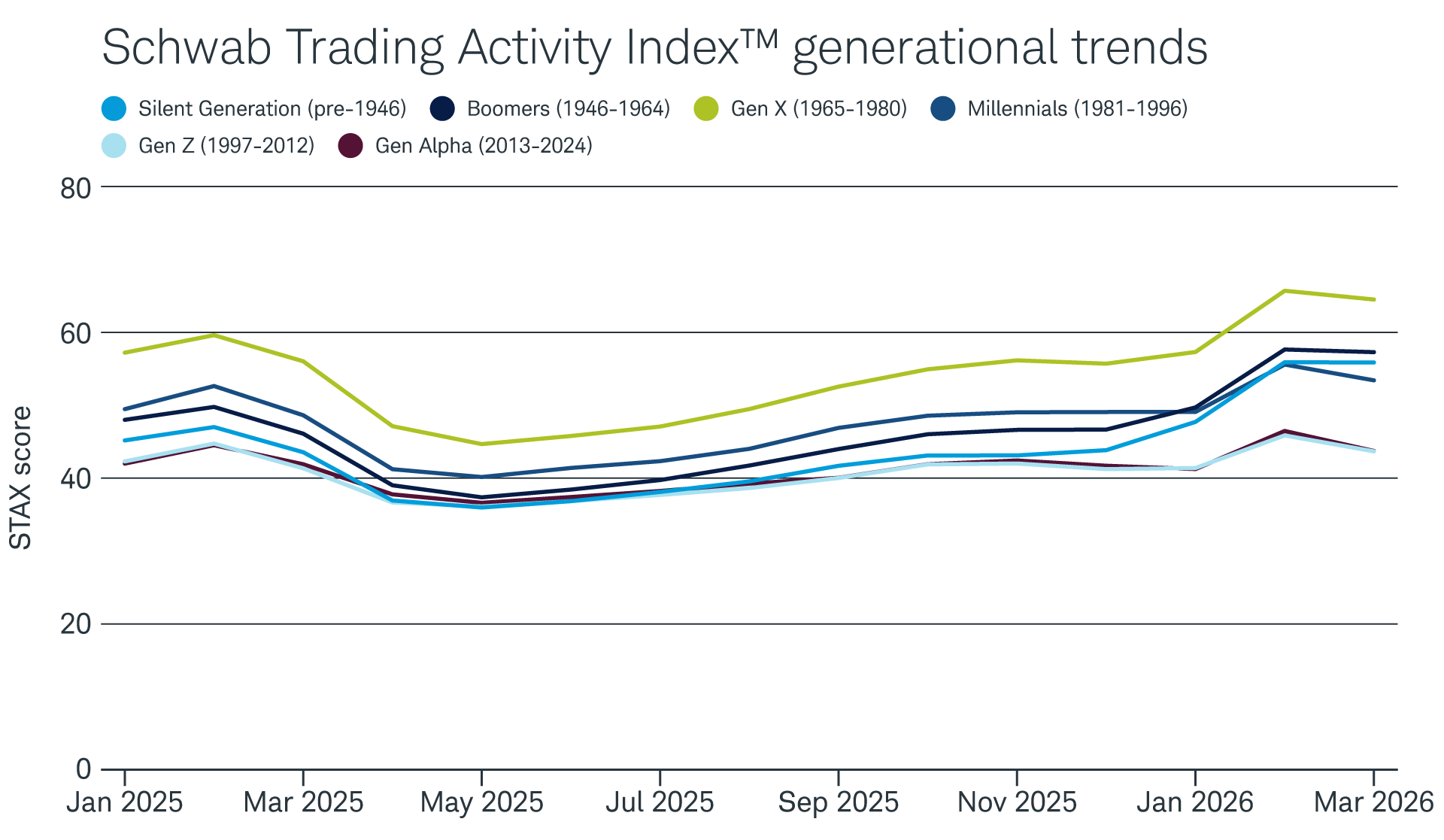
Source: Schwab
For illustrative purposes only.
STAX reports on what traders are actually doing with their money, not just what they say they're doing. Want to dig deeper into the latest retail investor trading activity? Check out March's STAX release.