What Is Swing Trading and How Does It Work?

Key takeaways
- Swing traders seek to capitalize on price swings over a period of days or weeks, typically using technical analysis to identify price patterns and entry and exit points.
- Unlike day traders, swing traders hold positions overnight but target shorter-term opportunities than position traders or long-term investors.
- Swing trading depends not only on spotting price patterns but also on disciplined execution, strict risk management, and the ability to accept that overnight gaps and failed setups can produce losses.
- Swing trading comes with significant risks. People with low risk tolerance, limited capital, or poor impulse control may want to avoid it.
In financial markets, a rising tide may lift all boats. But not everyone wants to wait for the tide to come in. They might turn to swing trading, an attempt to profit from shorter market "swings" that take place within longer-term trends or sideways consolidations.
Swing trading requires fluency in technical analysis, strict discipline, and emotional fortitude. Once developed, these difficult-to-acquire skills can position the trader to look for potential opportunities that many longer-term investors may ignore. But in addition to being challenging, swing trading carries risks, some of which are unique to the trading style.
What is swing trading?
Regardless of time frame, markets rarely go straight up or down. They move in waves, advancing and retreating, often forming patterns that may offer skilled traders insights on market conditions. Swing traders use technical and quantitative analysis to identify those patterns and attempt to profit from them. They may seek to enter the market at one turning point (such as a support or resistance level) and exit at another, try to catch a breakout move, or use one or more technical indicators for entry and exit signals. Many swing traders also track market fundamentals, longer-term trends, and economic cycles to ensure they aren't trading against the broader market.
Swing traders often use multiple time frames to execute a trade. For example, they may use a longer period (like a daily chart) for the trade setup but refer to an hourly chart when planning and executing entry and exit points. They might go long or short, with trades usually lasting days or a few weeks. (Shorting a stock requires an approved margin account and carries theoretically unlimited risk because a security's price can rise indefinitely.)
A basic swing trading system might include some or all of these components:
- Pattern recognition: A trade setup usually involves price levels, technical indicators, and trend awareness across multiple time frames.
- Quantitative analysis: Some traders use data or indicators to identify mean-reversion, breakout, and pullback trade opportunities.
- Risk-reward analysis: A swing trade plan often includes specialized exit orders called stops—and often predetermined profit targets—with both based on technical levels and/or risk-reward analysis. Some traders use trailing or volatility-based exits.
- Entry rules: Because the swing-trading system involves carefully calculated risks and rewards, traders tend to enter the trade based on a technical signal, whether from an indicator or a certain price level.
- Exit rules: When to exit a trade is often the most difficult decision. Swing traders use price levels, predetermined profit levels, and volatility guidelines, among other tools.
- Trading rules that enforce discipline: Some people are naturally inclined to make poor decisions about taking profits and losses. A few outsized losses resulting from poor discipline can wreck a swing-trading system. A commitment to a set of written trading rules is essential.
Swing trading vs. day trading
As a strategy, swing trading falls somewhere between day trading and longer-term position trading.
While both target shorter-term profits, day trading and swing trading differ in significant ways. The most obvious difference is that a day trade, by definition, is one in which the trader enters and exits the trade within the same trading day, holding positions for seconds, minutes, or hours. Swing traders, on the other hand, hold their positions for days or weeks. This exposes them to the risk of potential gaps at the market open due to news that occurred during non-trading hours.
Though they often track the news and short-term market sentiment, day traders pay little attention to market fundamentals, which are unlikely to shift within a single day. In contrast, because swing traders target market moves that transpire over days or weeks, they may pay more attention to broader market developments to ensure their trades align with the larger trading environment.
Swing trading vs. longer-term investing
Swing trading also differs from longer-term position trading. Like investors, position traders may hold a security for weeks or months. Longer holding periods often lead position traders to place greater weight than swing traders on business fundamentals, valuations, institutional money flows, and the economic backdrop.
Within those longer time horizons, most securities will naturally cycle through many smaller rallies and pullbacks. A position trader would likely weather these shifts as long as the trend remains intact, while a swing trader might target multiple trading opportunities within the longer move.
Common price patterns
Here are a few common chart patterns swing traders may look for. For more detailed examples of swing trading entry and exit strategies, check out Joe Mazzola's "The Ins and Outs of a Swing Trade."
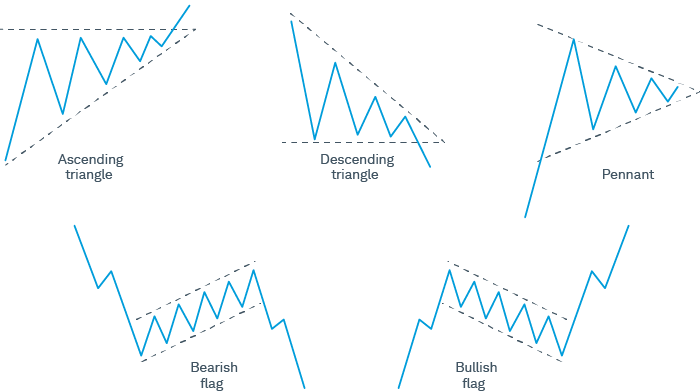
Example: Swing trading a breakout from a bullish flag
The image below illustrates a breakout from a bullish flag, a classic setup for a swing trade. Here's what a swing trader might look for in this hypothetical trading situation.
The "flagpole"
- Stock ZYX rallied from $150 to $185, a gain of about 23%, over three weeks.
- The rally came on high trading volume.
- The flagpole marks the scope of the gain.
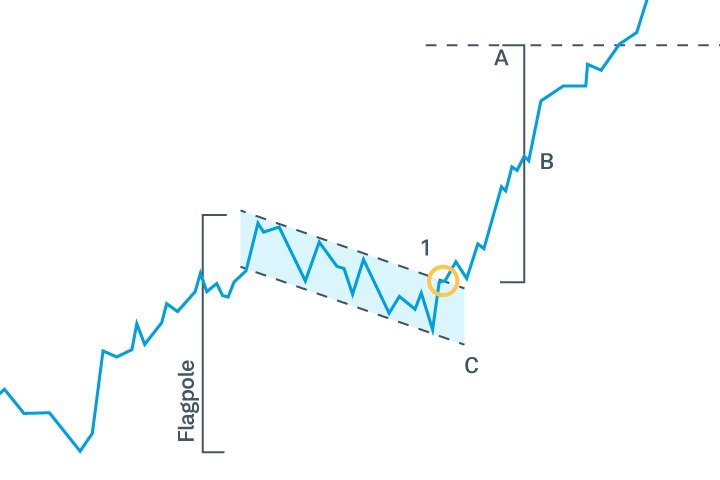
The flag forms
- Stock ZYX consolidates between $185 and $168 over the next couple of weeks, retracing roughly half of its earlier gain. Traders might say this flag is at "half-staff."
- Trading volume declines during this time, a key characteristic of bull flags.
- The price movement forms a modestly declining channel.
Trade entry
- After monitoring this technical action, a trader enters the trade (1) when the stock breaks out of the channel at $172 on increased volume.
- Price target B is $189.50, which represents about half the flagpole's length above the breakout point. The trader could take partial or full profits at this level.
- Price target A is $207, which marks a distance equal to the length of the original flagpole.
- Stop level C is $167.50 (below flag support) for an estimated risk per share of $4.50.
Exactly where to place stops is widely debated, and the answer largely depends on the trade setup. Some traders say a stop order should cut losses quickly while still giving the market enough room for natural price fluctuations. A stop might often be set at a level that would indicate the rationale behind the trade has failed to follow through. Keep in mind that stop orders are not guaranteed to execute at or even near the activation price. Once activated, they compete with other incoming market orders.
When bull flag trades work as intended—which is never guaranteed—a trader enters the position as the underlying security begins to resume its previous uptrend. By entering the trade at the breakout from the flag formation, the trader targets upward momentum but attempts to manage downside risk by placing a stop order.
Advantages and risks of swing trading
Some traders might use swing trading strategies to supplement a longer-term investment approach. Swing trades attempt to capture frequent short-term price movements within a market landscape that tends to evolve at a much slower pace. Attentive swing traders may see frequent trading opportunities when conditions are dynamic.
But those just beginning to experiment with swing trading should be mindful of key risks and remain conservative with any capital dedicated to this trading style.
Trading frequency: By definition, short-term trading opportunities occur more frequently, but more frequent trading brings more frequent exposure to risk and additional transaction costs. Any trader exploring swing trading should understand and be able to confidently manage the risks and costs that come with higher trading frequency.
Trading complexity: The many swing trading strategies traders use all share at least one thing in common: They require skill and experience to be consistently executed well. While price patterns look the same on charts, every short-term swing trading opportunity arises in a unique market scenario amid countless market conditions and participants, adding complexity. The more complexity, the greater the risk of misreading the market or executing poorly.
Patterns fail: Chart patterns can fail to produce the expected result. The same holds true of indicator-based or other quantitative trading techniques. That's why it's essential for swing traders to use strict risk management and faithfully execute a solid trading plan that includes a realistic win-loss ratio prediction.
Emotional control: Many swing trading strategies require entering and exiting trades during "live" markets. When money is on the line and the market is moving, fear and greed easily overtake decision-making, often with bad results. It's essential swing traders set ironclad trading rules and create practices that will put them in an optimal state of mind to make decisions while the market is moving.
Bottom line: Is swing trading the right strategy?
Swing trading is a specialized skill. It isn't for every trader, and not every trader can succeed at it. It takes a lot of time, practice, and experience to trade precise price swings.
It's one thing to use charts, indicators, and quantitative analysis to understand what's happening in the market. It's another thing entirely to profit from it. The difference comes from identifying a true market edge, using excellent risk management, and adhering to well-considered trading rules.
Those with a low risk tolerance, limited risk capital, or poor emotional control might want to avoid swing trading altogether. Others may find it a valuable skill that may potentially offer significant rewards to supplement longer-term investments. The right combination is different for every trader, so it's important to start with the basics of technical analysis before beginning to use indicators and patterns to guide actual trades.